What is a Data Warehouse?
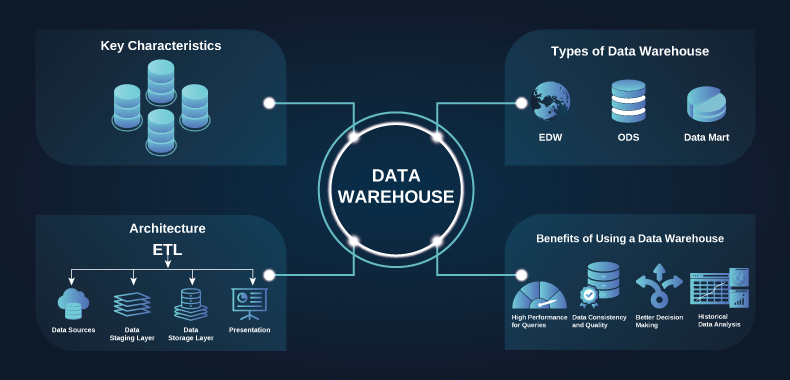
When it comes to turning raw data into powerful insight, a data warehouse is the game-changer. A data warehouse is the centralized system built to track, report, and break down the big picture of your data. And, this includes the past, the trends, why it happened, and what’s coming next. Designed for analysis and reporting of data, especially historical data, that is sourced from multiple operational systems, it is your “single source of truth.” Data warehouse solutions pull in structured and semi-structured data from everywhere, be it POS checkouts, CRM conversations, operational backend, and even third-party feeds. Then it gets to work, wherein it cleans, transforms, and stores it in analysis-ready formats. This results in fast, reliable insights that you put to use. At one place, you get everything you need without any silos. It is the ETL (extract, transform, load) process that smoothly determines the path of the data, optimizing it for end use. Thus, with data warehousing, you take a step ahead in collecting data to make business decisions with confidence.
Key Characteristics of a Data Warehouse
Subject-Oriented
A data warehouse is subject-oriented, as it tends to organise data around key business topics, not daily operations. So, be it sales, inventory, or customers, you can perform strategic analysis. And, such subject orientation makes decision-making a breezy task, with an emphasis on modeling and analytics over transactions.
Integrated
Another important part of a data warehouse is integration. It doesn’t just get data from all sources; it mixes it together. This means that data is combined not only from operational systems, but also from metadata and external data, which brings together data that is not related to each other. The data warehouse gives you a single, unified view by cleaning, changing, and combining processes.
Time-Variant
What’s a game-changer about a data warehouse is time. And not time as a timestamp, but time as context. It informs you when and how the data changed. A data warehouse keeps and handles data over varying time spans to enable historical analysis. Data is organized in a sequence of snapshots, and the time-aware organization allows users to see what’s trending and what’s not by tracking and comparing performance week by week, month after month, or year after year.
Non-Volatile
In data mining, a data warehouse is non-volatile, meaning that the past cannot be changed or erased. The information won’t change once it reaches the data warehouse. Because every trend has a trail and every number has a timestamp, it also contributes to the development of trust. Since there is only initial loading and access and no operational data update, it is extremely stable.
Types of Data Warehouse
Enterprise Data Warehouse (EDW)
The Enterprise Data Warehouse is a database that centralizes a business’s information from across an entire organization. With this, you can ensure consistent analysis and reporting across all departments. Whether it is structured stats or unstructured data, EDW handles it all. And, EDW is ideal for large-scale business intelligence to facilitate decision-support services throughout the enterprise.
Operational Data Store (ODS)
ODS is fast, real-time, giving you a critical edge in your business. It is a centralized database consolidating current operational data to support your daily operations. It provides a current snapshot of data, making it ideal for quick reads and fast decisions. It also checks and cleans your data as it comes in, resolving redundancy and ensuring compliance with business rules.
Data Mart
A Data Mart is small, sharp, and precise. It is a subset of a data warehouse, with a specific focus on a particular line of business, be it sales, marketing, or finance. It provides targeted insights and efficient querying. With a data mart, you can enjoy fast access, a tight scope, and accuracy. There are different types of data mart, such as Independent, Dependent, and Hybrid Data Marts, depending on their relationship to the central data warehouse.
Data Warehouse Architecture
Data Warehouse Architecture is a set of interconnected databases that help store, organize, and analyze data. The three-tier architecture is most common, wherein the bottom tier is a relational database, the middle tier is the application layer, often using OLAP, and the top tier is where the user proceeds to access and interact with the data. It gives you speed and simplicity to make sure your analytics game runs smoothly.
Components
Data sources
The raw data starts at the data source. These sources fall into one of two categories: internal or external. Examples of internal sources include databases, ERP, CRM, and spreadsheets. On the other hand, external sources include things like market research, IoT devices, and social media. When these sources come together, the warehouse’s efficiency rises.
Data storage
Data storage serves as a central repository for a warehouse. Here, it organises the processed data so that it can be readily retrieved when needed. Additionally, it contains data marts for department-specific insights and a data warehouse database for structured and unstructured data for simple classification.
ETL tools
ETL (Extract, Transform, Load) tools combine information from various sources. Prior to being loaded into the warehouse, it converts it into formats that are consistent. For the best quality control, this is where data cleansing, mapping, filtering, and aggregation occur.
Data staging area
This is a temporary space where it stores raw data before it goes into the warehouse. Everything gets cleaned and sorted here before it heads further. The staging area acts as a buffer between raw sources and the final repository.
Metadata and tools
A data warehouse’s roadmap is its metadata. It explains the context, structure, cleaned data, its movement, and its future direction. Data exploration and dashboard creation are made possible by access tools such as OLAP and reporting software.
Benefits of Using a Data Warehouse
High Performance for Queries
Speed is the defining factor for any business, wherein data plays a central role. A data warehouse builds up the pathway for speed. You can easily identify sales trends, get insights on the dashboard, and deal with clean data with the help of the warehouse. Consequently, it makes it easier for you to handle complex queries.
Data Consistency and Quality
Elimination of data chaos is a pre-determining factor for business success. With the help of a warehouse, it smoothens the pathway for consistent and quality data, without any scope for errors. Data warehouse transforms it into one standard for trust and reliability.
Better Decision Making
A data warehouse gives access to integrated and historical data, so that businesses can stop reacting and start predicting. With the data warehouse, trends, insights, and answers are always live and ready. Quick insights power fast decision-making. Consolidated data makes sure the whole team is on the same page. And, business-critical information supports strategic moves.
Historical Data Analysis
Everyone wants to see the future. But the key move is to start with the past. Data warehouses remember everything. Historical data is a treasure trove, and if you know how to read it, it shows you what’s next. Dara warehouse in DBMS analyzes different time periods, spots the patterns, and thus helps you make predictions. It brings historical intelligence that holds valuable clues for business preparedness.
Why Choose ServerBasket’s Autonomous Data Warehouse?
Data Security
ServerBasket’s Autonomous Data Warehouse keeps your data safe with strong security features like encryption, role-based access, firewalls, and 24/7 monitoring. We ensure complete protection of your information from unauthorized access while ensuring compliance.
Data Warehouse Solution
Our warehouse isn’t just a place to store data, but it is also a smart tool for your business. It brings all your data together, ensuring easy searchability. You can now stay fast with reliable insights. Built for growth with your business, it facilitates better decisions.
Cost of Solution
We ensure a price-match guarantee with high ROI with our Autonomous Data Warehouse. The cost depends on your needs, based on size and features. Other costs include tools, software, and skilled people to manage it, with supreme customization.
Data Governance
At ServerBasket, we have the best provisions for data governance to manage your data the right way. We help keep your data clean, organized while ensuring security. You can trust your data and eliminate any scope of confusion with our services.